
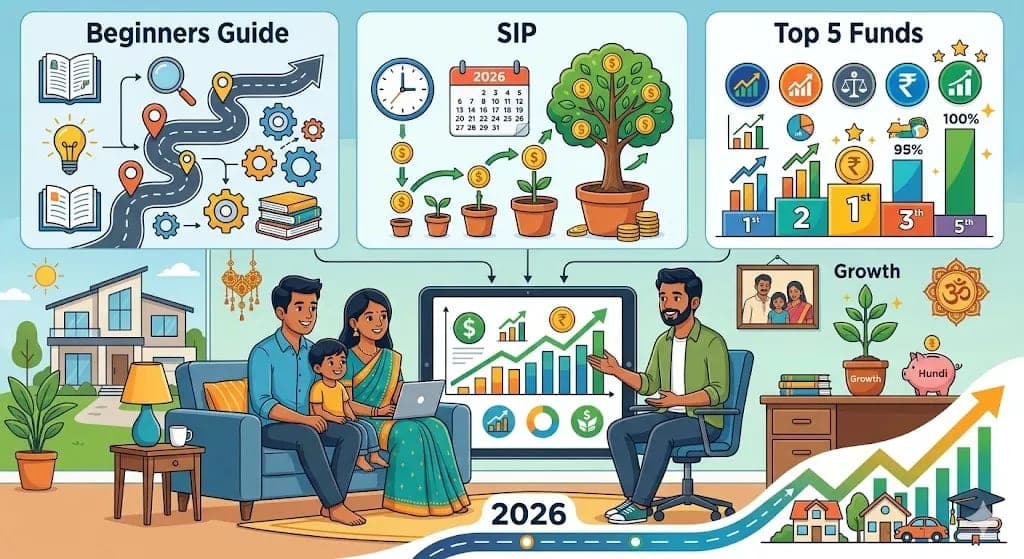
జూన్ 10, 2026: భారత mutual fund industry AUM ₹70+ లక్షల కోట్లు cross చేసింది — SIP monthly inflow ₹26,000+ కోట్లు. మహిళలు + యువత retail investors rapidly grow. కానీ "MF అంటే ఏమిటి? SIP ఎలా start చేయాలి? ఏ fund choose చేయాలి?" — Confusion common. ఈ guide complete beginner-friendly + step-by-step + risk-based + top 5 funds + 5-year roadmap ఇస్తుంది.
Mutual Fund అంటే ఏమిటి? — Simple Explanation
Imagine: మీరు + 100 ఇతర investors ప్రతి ఒక్కరూ ₹1000 contribute చేస్తారు. మొత్తం ₹1,00,000 pool అవుతుంది. ఈ pool ను SEBI-registered Fund Manager stocks, bonds, gold లాంటి assets లో invest చేస్తాడు. Fund grow అయితే ప్రతి investor's share అదే ratio లో grow అవుతుంది.
Key Concepts
- AMC (Asset Management Company) — HDFC AMC, SBI AMC, Mirae Asset
- NAV (Net Asset Value) — Fund's "stock price"; daily updates
- Units — Mutual fund's "shares"
- Expense Ratio — Annual fee % (Direct = 0.2-1.0%; Regular = 1.5-2.5%)
- Exit Load — Early exit penalty (typically 1% within 1 yr)
SIP vs Lumpsum — ఏది better?
SIP (Systematic Investment Plan)
- Monthly fixed amount invest (₹500-₹50,000+)
- Rupee Cost Averaging — Market high అయితే తక్కువ units; low అయితే ఎక్కువ units = average cost reduction
- Discipline + automation
- Long-term wealth creation
- Beginners ideal
Lumpsum (One-time)
- Large single investment (bonus, inheritance, FD maturity)
- Market timing risk
- Lower long-term returns vs SIP (if invested at peak)
- Best for: STP (Systematic Transfer Plan) liquid fund → equity
Verdict
- Beginners + Regular income → SIP
- Large amount + STP discipline → Lumpsum via STP
- Combination: Lumpsum into liquid + STP → equity monthly
Mutual Fund Types — Risk-Based
Equity Mutual Funds (High risk + High return)
| Sub-type | Risk | Returns (5-yr avg) |
|---|---|---|
| Large Cap (Top 100 companies) | Moderate | ~12-14% |
| Mid Cap (101-250 companies) | High | ~14-18% |
| Small Cap (Below 250) | Very High | ~16-22% |
| Flexi Cap (Any-cap) | Moderate-High | ~14-17% |
| Index Funds (Nifty 50) | Moderate | ~13% |
| Sector / Thematic | Very High | varies wildly |
| ELSS (Tax saving) | High | ~14-15% |
Debt Mutual Funds (Low risk + Moderate return)
| Sub-type | Risk | Returns |
|---|---|---|
| Liquid Funds | Very Low | ~6-7% |
| Short Duration | Low | ~7-8% |
| Corporate Bond | Low-Moderate | ~7-9% |
| Gilt Funds (Govt bonds) | Low | ~7-8% |
| Credit Risk | High | ~8-10% |
Hybrid Mutual Funds (Mixed)
- Aggressive Hybrid — 65-80% equity (Higher returns; less volatility)
- Balanced Advantage — Dynamic equity-debt (auto-allocation)
- Conservative Hybrid — 10-25% equity (Stable returns)
Top 5 Mutual Funds — 2026 Beginner Picks
(5-year average returns; past performance ≠ future. SEBI-registered Direct Growth plans only.)
1. UTI Nifty 50 Index Fund (Direct Growth)
- Type: Index Fund (Passive)
- Expense Ratio: 0.20% (lowest)
- 5-yr Returns: ~13.5%
- Best for: Absolute beginners, simplicity
- Minimum SIP: ₹500
2. Parag Parikh Flexi Cap Fund (Direct Growth)
- Type: Flexi Cap (Domestic + International)
- Expense Ratio: 0.65%
- 5-yr Returns: ~17-18%
- Best for: Long-term wealth creation + global diversification
- Minimum SIP: ₹1,000
3. HDFC Mid Cap Opportunities (Direct Growth)
- Type: Mid Cap
- Expense Ratio: 0.83%
- 5-yr Returns: ~19-22%
- Best for: Aggressive long-term (7+ years)
- Minimum SIP: ₹500
4. Mirae Asset ELSS Tax Saver (Direct Growth)
- Type: ELSS (Tax saving)
- Lock-in: 3 years
- Tax benefit: Section 80C ₹1.5L deduction
- 5-yr Returns: ~17-19%
- Minimum SIP: ₹500
5. HDFC Balanced Advantage Fund (Direct Growth)
- Type: Dynamic Asset Allocation (Hybrid)
- Expense Ratio: 0.71%
- 5-yr Returns: ~14-15%
- Best for: Moderate risk-tolerance; first-time + volatility-averse investors
- Minimum SIP: ₹1,000
Step-by-Step Start Guide
Step 1: KYC (15-30 minutes one-time)
- PAN + Aadhaar essential
- Online KYC: Karvy, CAMS, NSDL portals
- Video KYC available (one-time biometric)
- Bank account active + mobile linked
Step 2: App Choose (Direct Plans only)
| App | Best For | Cost |
|---|---|---|
| Groww | Beginners + UI | Free (Direct) |
| Zerodha Coin | Active investors | Free (Direct) |
| ET Money | Auto-suggestions | Free |
| Kuvera | Goal-based planning | Free |
| Paytm Money | UPI lovers | Free |
Critical: Always "Direct Growth" plan select (1-1.5% lower expense vs Regular plan; massive difference long-term).
Step 3: Goal-Based Allocation
Short-term (1-3 years)
- Debt funds — Liquid or Short duration
- Bank FD alternative
Medium-term (3-7 years)
- Hybrid — Aggressive or Balanced Advantage
- Large Cap or Index Fund SIP
Long-term (7+ years)
- Equity — Flexi Cap + Mid Cap + Index
- SIP step-up (annually 10% increase)
Step 4: SIP Setup
- Fund select
- SIP amount + date set (Best: 1st of month after salary)
- Auto-debit mandate (UPI / Net banking)
- Email + SMS confirmation
Step 5: Track + Stay Calm
- Monthly review (not daily)
- Annual rebalancing
- Market crash → Don't stop SIP (best time to buy)
- Goals review yearly + adjust
Common Mistakes
- Regular Plan select → 1.5% extra commission → ₹10L corpus → ₹3L+ loss long-term
- Market crash panic-selling — Worst time to exit
- Too many funds (10+) — Over-diversification; tracking nightmare
- Past performance chasing — Top fund last year ≠ next year
- SIP stopping during downturns — Cost averaging benefit lose
- Goal-less investing — No deadline → No discipline
- Sector funds for beginners — High volatility; concentration risk
Tax on Mutual Funds
Equity Funds
- STCG (< 1 yr): 20%
- LTCG (> 1 yr): 12.5% (above ₹1.25L exemption)
Debt Funds (from April 2023)
- All gains taxed at slab rate (regardless of holding period)
- Indexation benefit removed
ELSS
- Section 80C ₹1.5L deduction during investment
- Gains taxed as Equity (LTCG)
FAQ
Q1. ₹500 SIP తో start చేయవచ్చా?
అవును — Most funds ₹500 minimum SIP. ₹100/week SIP also available some funds.
Q2. Mutual fund secure ఎంత?
SEBI regulated + Fund's stocks/bonds segregated. AMC issue అయితే funds investor protected. Stock market risk inherent — long-term horizon (7+ yrs) → smoothing.
Q3. Direct vs Regular plan తేడా ఎంత?
Regular plan 1-1.5% extra commission. ₹10L corpus 20-yr later: Direct ~₹2cr, Regular ~₹1.6cr (₹40L loss).
Q4. SIP date salary రోజు తర్వాత set చేయవచ్చా?
అవును — 1st, 5th, 10th common dates. Salary credit తర్వాత 1-2 days date set చేయండి (insufficient balance avoidance).
Q5. Fund exit ఎప్పుడు చేయాలి?
Goal achieve అయితే. Fund consistently underperformance (3+ yrs) → switch. Crash లో exit NEVER (loss locked).
సంబంధిత గైడ్లు
- డబ్బు పొదుపు 2026 — Complete Guide
- Income Tax Saving 2026 — 80C/80D
- ₹5,000/నెల Save + Invest — Entry-Level
డిస్క్లైమర్: Mutual funds market-linked; risks ఉంటాయి. Past performance ≠ future returns. SEBI-registered Financial Advisor consult before significant investments. Scheme Information Document (SID) carefully read. tvaartha.com investment recommendation ఇవ్వదు; educational purposes మాత్రమే.



వ్యాఖ్యలు (0)
ఇంకా వ్యాఖ్యలు లేవు. మొదటి వ్యాఖ్య మీదే!