
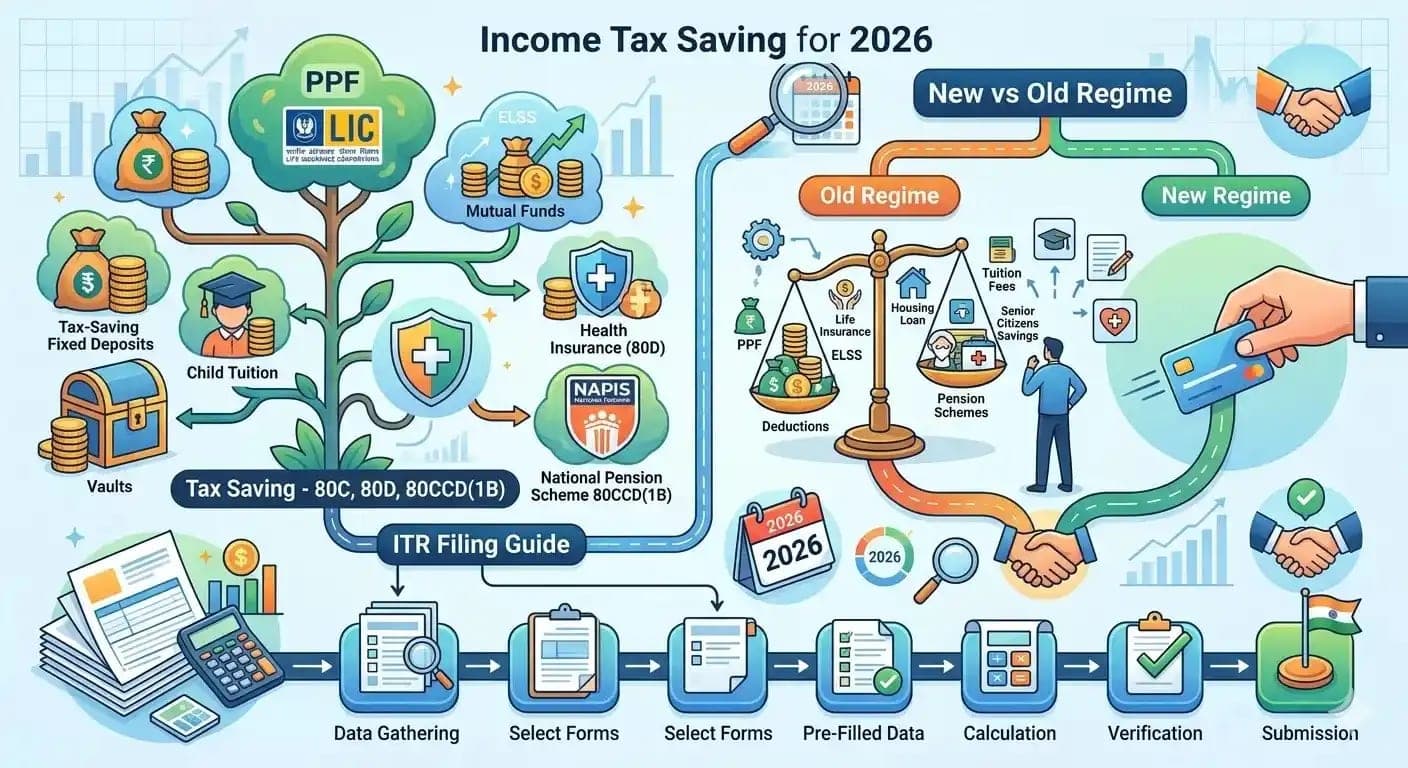
జూన్ 10, 2026: Financial Year 2025-26 (AY 2026-27) ITR filing deadline జూలై 31, 2026. Income tax save చేయడం ఇంకా mostly Old Regime taxpayers కు relevant — Section 80C (₹1.5L) + 80D + 80CCD(1B) + ఇతర deductions. New Tax Regime default అయ్యింది 2024-25 నుండి; ఏది better? ఈ guide section-by-section tax deductions + new vs old regime comparison + step-by-step ITR filing guidance ఇస్తుంది. (సోర్స్: incometax.gov.in official.)
మొదట — Tax Slabs 2025-26 (AY 2026-27)
Old Regime (Deductions allowed)
| Income Slab | Tax Rate |
|---|---|
| ₹0 — ₹2.5L | 0% |
| ₹2.5L — ₹5L | 5% |
| ₹5L — ₹10L | 20% |
| Above ₹10L | 30% |
+ 4% Health & Education Cess
New Regime (No deductions; lower slabs)
| Income Slab | Tax Rate |
|---|---|
| ₹0 — ₹3L | 0% |
| ₹3L — ₹7L | 5% |
| ₹7L — ₹10L | 10% |
| ₹10L — ₹12L | 15% |
| ₹12L — ₹15L | 20% |
| Above ₹15L | 30% |
+ Standard Deduction ₹75,000 (salaried) | + Section 87A rebate (income up to ₹7L = NIL tax)
Section 80C — ₹1,50,000 Limit (Old Regime Only)
Eligible Investments + Expenses
| Instrument | Lock-in | Returns | Risk |
|---|---|---|---|
| PPF | 15 years | 7.1% (Tax-free EEE) | Zero (Govt backed) |
| ELSS Mutual Funds | 3 years | 12-15% (Long-term) | Market-linked |
| 5-year Tax-Saving FD | 5 years | 6.5-7.5% | Zero |
| NSC | 5 years | 7.7% | Zero (Govt) |
| Sukanya Samriddhi Yojana (girl child) | 21 years | 8.2% | Zero |
| EPF Contribution | Retirement | 8.25% | Zero |
| Life Insurance Premium | — | — | — |
| Home Loan Principal | — | — | — |
| Tuition Fees (up to 2 children) | — | — | — |
| ULIP | 5 years | varies | Market |
Best ₹1.5L Allocation Strategies
If risk-averse (40+ age)
- PPF ₹1L + Tax-saving FD ₹50K — 100% guaranteed; tax-free PPF
If balanced (30-40 age)
- PPF ₹50K + ELSS ₹1L — Long-term growth; tax-free + market
If aggressive growth (20-30 age)
- ELSS ₹1.5L — 12-15% growth + lowest lock-in (3 years)
Section 80D — Health Insurance Premium
| Category | Deduction Limit |
|---|---|
| Self + family (below 60 yr) | ₹25,000 |
| Parents (below 60 yr) | +₹25,000 = Total ₹50,000 |
| Self + family + Parents (any senior 60+) | +₹50,000 → Total ₹75,000 |
| Both Self/family AND Parents senior (60+) | ₹50K + ₹50K = ₹1,00,000 |
| Preventive health checkup (within above limits) | ₹5,000 |
Best Approach
- Yourself + family — ₹5-10L coverage; ~₹15-25K premium
- Parents — ₹5-10L; ~₹30-50K premium (age-dependent)
- Top-up / Super top-up — Cost-effective expansion
- Critical Illness Rider — Cancer / Heart attack lumpsum
Section 80CCD(1B) — Additional ₹50,000 (NPS)
NPS Highlights
- Additional ₹50,000 deduction over and above ₹1.5L 80C limit
- Total potential: 80C ₹1.5L + 80CCD(1B) ₹50K = ₹2L deduction
- Tier I (locked till retirement) + Tier II (flexible)
- Returns: 8-12% (equity + debt mix)
- Maturity: 60% lumpsum + 40% annuity (mandatory)
Tax Savings Calculation
30% tax bracket + ₹50K NPS = ₹15,000 tax saved/yr
Other Important Deductions
Section 80E — Education Loan Interest
- No upper limit on interest deduction
- 8 years from loan repayment start
- Self / spouse / children higher education
Section 80EE / 80EEA — Home Loan Interest (additional)
- First-time home buyers
- ₹50K (80EE) / ₹1.5L (80EEA) extra interest
- Property value limits + loan conditions
Section 24 — Home Loan Interest
- Self-occupied: ₹2,00,000 interest deduction
- Let-out property: No limit
Section 80TTA / 80TTB — Savings Account Interest
- 80TTA: ₹10,000 (below 60 yr)
- 80TTB: ₹50,000 (60+ senior citizens)
Section 80G — Donations
- PM CARES Fund: 100% deduction
- PM National Relief: 100%
- NGOs registered: 50% (typically)
HRA (House Rent Allowance)
- Salaried employees + actual rent paid
- Minimum of: Actual HRA / 50% basic (metro) or 40% (non-metro) / Rent - 10% basic
New vs Old Regime — Decision Matrix
Old Regime Better If:
- You can claim deductions ₹3-5L+
- Home loan EMI (Section 24 ₹2L)
- HRA exemption available
- Insurance + PPF + ELSS regular investments
- Significant donations + education loan
New Regime Better If:
- Few or no deductions claimable
- Income ₹7L or below (₹0 tax via 87A rebate)
- Simplicity preferred over investment-driven planning
- Standard salary structure
Quick Decision Matrix
| Salary | Old Better If Deductions ≥ |
|---|---|
| ₹7-10L | ₹1.5L+ |
| ₹10-15L | ₹2.5L+ |
| ₹15-20L | ₹3.5L+ |
| ₹20-30L | ₹4.5L+ |
| ₹30L+ | ₹5L+ |
Income Tax Department Tax Calculator ఉపయోగించి personalized comparison: incometax.gov.in calculator.
ITR Filing — Step-by-Step (AY 2026-27)
Deadlines
- Salaried (audit not required): July 31, 2026
- Audit cases: October 31, 2026
- Transfer pricing: November 30, 2026
- Belated return: December 31, 2026 (with penalty)
Documents Required
- Form 16 (Employer)
- Form 26AS (TDS statement) — Auto-fetched
- AIS (Annual Information Statement) — Income data
- Bank statements + Investment proofs
- Aadhaar + PAN
- Rent receipts (HRA claim)
- Home loan certificate (Section 24)
- Insurance premium receipts (80D)
- Capital gains statements (broker)
ITR Forms — Which One?
| Form | For Whom |
|---|---|
| ITR-1 (Sahaj) | Salary + 1 house property + total income up to ₹50L |
| ITR-2 | Salary + multiple house property + capital gains + foreign income |
| ITR-3 | Business + profession income |
| ITR-4 (Sugam) | Presumptive business income (Section 44AD/ADA/AE); freelancers |
Filing Process
- Login: incometax.gov.in → e-Filing portal
- "File Income Tax Return"
- Choose AY 2026-27 + Status (Individual)
- ITR form select
- Form 26AS + AIS auto-prefilled data verify
- Deductions (80C, 80D, etc.) enter
- Tax computation auto-shows
- e-Verify (Aadhaar OTP / Net Banking / EVC)
- Acknowledgement download + save
Common Mistakes to Avoid
- Form 26AS + AIS mismatch — Cross-verify
- Wrong ITR form selection
- Missing bank account interest income
- Crypto transactions undeclared
- Old Regime selected but no deductions
- e-Verification missed → return invalid
- Late filing penalty (₹1K-5K)
Tax Calculation Example — ₹12L Salary
Old Regime (with deductions ₹3L)
- Gross income: ₹12,00,000
- Standard deduction: ₹50,000
- Section 80C: ₹1,50,000
- Section 80D: ₹25,000
- Section 80CCD(1B): ₹50,000
- Section 24 (interest): ₹25,000
- Taxable income: ₹9,00,000
- Tax: ₹92,500 + Cess 4% = ₹96,200
New Regime (no deductions)
- Gross income: ₹12,00,000
- Standard deduction: ₹75,000
- Taxable income: ₹11,25,000
- Tax (slabs): ₹65,000 + Cess 4% = ₹67,600
Conclusion: New Regime saves ~₹28,600 in this case. But if person can claim home loan principal + interest + extra deductions = ₹5L, Old Regime might be better.
FAQ
Q1. ELSS lock-in 3 yrs — exit ఎలా?
3 yrs తర్వాత anytime redeem. Long-term capital gains tax 10% (₹1L exemption above).
Q2. PPF account spouse + children name లో open చేయవచ్చా?
అవును — Self + Spouse + minor children (one per minor). Combined limit ₹1.5L (deduction self account only).
Q3. NPS vs PPF — ఏది better?
PPF — guaranteed + tax-free + fully withdraw at maturity. NPS — higher returns potential + extra ₹50K deduction; కానీ 40% annuity mandatory (fixed pension; not lump sum).
Q4. New Regime select చేస్తే తరువాత మళ్ళీ Old కి switch చేయవచ్చా?
Salaried: Every year choose చేయవచ్చు. Business income: One-time switch lifetime.
Q5. Freelancer / Self-employed — Tax planning ఎలా?
Section 44ADA — 50% income deemed; balance untaxed for IT consulting/professional. 80C + 80D + 80CCD(1B) full benefits.
సోర్సెస్
సంబంధిత గైడ్లు
డిస్క్లైమర్: Tax computation specific personal financial situation ఆధారం; Chartered Accountant / Tax Professional consult highly recommended. Tax laws + slabs Govt notification ప్రకారం మారతాయి. Latest official information కోసం incometax.gov.in verify చేయండి.



వ్యాఖ్యలు (0)
ఇంకా వ్యాఖ్యలు లేవు. మొదటి వ్యాఖ్య మీదే!